For professional salon product lines, a hair dryer has much more importance than simply acting as a styling tool. This includes its impact on drying time, comfort of the stylist, service process, and after-sale pressure from the distributors. While a hair dryer that works great in rare occasions at home will likely behave differently in a professional salon environment.
That is why motor type matters. Traditional brushed motor hair dryers still fit entry-level retail and price-driven channels. A BLDC hair dryer is usually a better match for salon-grade product lines where airflow, weight balance, noise control, and maintenance all influence the buying decision.
Link Beauty develops professional hair styling tools for salon and commercial buyers. In this article, the Link Beauty 2012 Large Power 2400W BLDC Blower is used as a practical example of how a BLDC hair dryer can meet the performance needs of premium salon product lines.

Why Motor Choice Matters for Salon Product Lines
Professional Use Creates a Heavier Workload
Salon dryers are used repeatedly throughout the day. They handle thick hair, long hair, color-treated hair, and quick service appointments with only short breaks between users. This daily workload puts more pressure on the motor, air duct, housing, and filter system.
A salon hair dryer needs more than strong heat. It needs steady airflow, controlled temperature, comfortable handling, and a motor system that can support repeated commercial use.
Buyers Look Beyond Wattage
Wattage is important, but not enough for the majority of salon buyers. In sample testing, salon buyers pay more attention to airflow stabilization, weight, noise level, heat stabilization, and cleaning design.
In regard to B2B purchasing, the high-end salon hair dryer must be evaluated in its totality, and not just for its high power rating alone. The criteria such as motor type, revolutions per minute, wind velocity, air volume, handling ease, noise level, heat stabilization, negative ion generation, and supplier testing ability can determine its suitability for daily salon operations.
How Brushed Motor Hair Dryers Fit Cost-Sensitive Channels
A brushed motor uses carbon brushes to transfer current and drive rotation. This structure is mature, common, and cost-friendly, which makes brushed motor hair dryers suitable for basic home use, promotional beauty kits, budget hotel supply, and entry-level retail programs.
The limitation appears under higher-frequency use. Since brushed motors rely on carbon brush contact, wear may develop over time. This can lead to performance drop, noise changes, or higher maintenance needs.
For price-led product lines, a brushed motor hair dryer can still be a practical choice. For premium salon lines, however, the product usually needs stronger airflow, smoother handling, and lower maintenance pressure.
Why BLDC Hair Dryer Technology Fits Professional Salon Use
Less Brush-Related Wear
A BLDC hair dryer uses a brushless DC motor, so it does not rely on carbon brush contact in the same way as a traditional brushed motor. With less brush-related friction, the motor design can support smoother operation and lower maintenance pressure over repeated commercial use.
For salon distributors and private label buyers, this is more than a technical difference. It affects how the product performs after months of daily use, especially in channels where dryers are handled by multiple stylists and used for long service hours.
Stronger Airflow for Daily Salon Work
In salon work, drying speed is not only about heat. Strong airflow helps remove moisture faster while giving stylists better control during shaping and finishing.
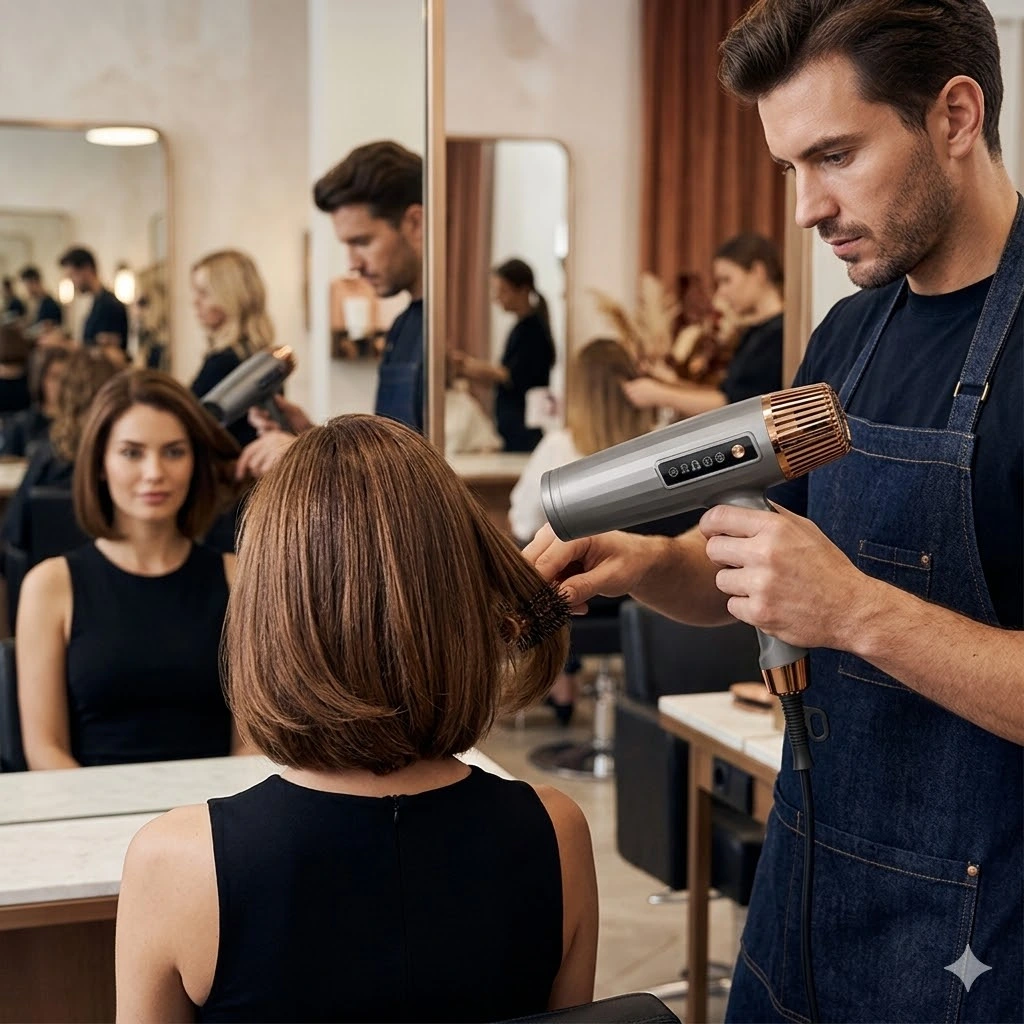
The Link Beauty 2012 BLDC Blower uses a high-speed BLDC motor and is designed for strong airflow performance. Instead of treating the product only as a high-wattage dryer, buyers can evaluate it as a salon-oriented tool where motor speed, air volume, weight, and maintenance design work together.
Key Differences Between BLDC and Brushed Motor Hair Dryers
Weight and Handling
Weight differences may look small in a specification sheet, but stylists feel them during repeated blow-drying sessions. A dryer that feels fine for two minutes may feel tiring after several long services.
The Link Beauty 2012 BLDC Blower has a listed weight of 345g. This lightweight body supports easier handling during long salon shifts and helps reduce hand fatigue during detailed finishing work.
Noise and Service Atmosphere
Salon environments already include conversations, clippers, water, music, phones, and multiple tools running at once. Dryer noise can affect both stylist comfort and client experience.
The Link Beauty 2012 BLDC Blower lists a noise level of 74dB ±1. Noise performance depends on the full dryer structure, but BLDC designs often give manufacturers more room to build smoother operation into professional salon hair dryer products.
Maintenance and Product Lifecycle
Maintenance is easy to overlook during sample selection, but it becomes important after repeated salon use. Hair, dust, and debris may build up inside the dryer over time.
The Link Beauty 2012 BLDC Blower includes a self-cleaning system designed to remove internal hair debris and dust. For B2B buyers, this can help reduce maintenance frequency and after-sales pressure.
From a lifecycle view, lower brush-related wear and easier cleaning may also reduce early replacement.
Product Parameter Comparison for Salon Buyers
| Comparison Point | Brushed Motor Hair Dryer | BLDC Hair Dryer | Link Beauty 2012 BLDC Blower |
|---|---|---|---|
| Motor design | Carbon brush structure | Brushless DC motor | φ32 BLDC motor |
| Product tier | Basic or cost-sensitive lines | Professional salon lines | Large-power BLDC blower |
| Power | Varies by model | Varies by design | 2400W |
| Motor speed | Varies by model | High-speed potential | 90,000RPM |
| Weight | Depends on design | Often lighter | 345g |
| Wind speed | Varies by air duct design | Strong airflow potential | 22m/s ±1 |
| Air volume | Varies by structure | Stable airflow potential | 1.8m³/min |
| Noise | Depends on structure | Smoother operation potential | 74dB ±1 |
| Maintenance | Brush wear may occur | Lower brush-related wear | Self-cleaning system |
| Hair care feature | Basic drying focus | Can support added care features | Negative ion output |
Why BLDC Hair Dryers Are Better Matched with Premium Salon Lines
A salon-grade dryer should not rely on wattage alone. In professional use, buyers also need to consider how the dryer feels after repeated services, whether airflow remains stable, and how much maintenance the product may require after months of use.
This is where a BLDC hair dryer has stronger value for premium salon product lines. The Link Beauty model combines high-speed motor performance with lightweight handling and practical maintenance design, giving distributors and private label buyers a clearer product story than a standard high-power dryer.
For salon channels, this matters. A dryer must be easy to test, easy to explain, and credible when placed beside other professional styling tools. Features such as strong airflow, lower brush-related wear, self-cleaning design, and negative ion hair care all support that positioning without needing to repeat every technical parameter in the sales copy.
How B2B Buyers Should Choose the Right Motor Type
Motor selection should match the product tier and sales channel. For basic retail or price-sensitive programs, a brushed motor hair dryer may still be reasonable. For salon distributors, beauty chains, and private label professional tools, a BLDC hair dryer is usually the better fit.
Buyers should review real product data before placing bulk orders. Key points include motor speed, wind speed, air volume, noise level, weight, power, temperature control, ion output, cleaning design, and supplier testing capability.
The supplier behind the product also matters. Link Beauty’s factory information includes mold making, product research and development, PCBA production, production line testing, hair dryer aging testing, and laboratory testing. These capabilities support more stable bulk production and product consistency.
Conclusion
Brushed motor hair dryers remain appropriate for price-sensitive markets and basic product lines. In terms of a more upscale salon product line, it will be better to go with a BLDC hair dryer since it facilitates greater air flow, lightweight operation, lesser wear from brushes, and a higher level of service experience.
The Link Beauty 2012 Large Power 2400W BLDC Blower works well as a professional product example since it combines functionality with saloon requirements like high drying efficiency, handling comfort, minimal maintenance requirements, and finishing effect. For distributors, salon chains, and private label buyers building a professional dryer range, Link Beauty can support product selection, bulk supply discussion, and customization based on target market needs.
FAQ
Q1: Is a BLDC hair dryer better than a brushed motor hair dryer for salon use?
A: For professional salon lines, a BLDC hair dryer is usually better because it supports stronger airflow, lower brush-related wear, and better long-term positioning.
Q2: Does a brushed motor hair dryer still have value in B2B markets?
A: Yes. It can fit entry-level retail, promotional channels, and price-sensitive markets where basic drying performance is enough.
Q3: Why does motor speed matter in a salon hair dryer?
A: Motor speed affects airflow response and drying efficiency, especially during repeated salon services.
Q4: What should buyers check before ordering a premium salon hair dryer?
A: Buyers should check motor type, wattage, airflow, weight, noise level, heat control, cleaning design, and supplier testing capability.
Q5: Is the Link Beauty 2012 BLDC Blower suitable for premium salon product lines?
A: Yes. Its BLDC motor, lightweight body, self-cleaning design, and negative ion function make it suitable for professional salon hair dryer ranges.