Choosing a professional dryer used to be a simple decision. High wattage, solid body, decent heat, and done. That worked for years. In 2026, salon buyers look at the tool a little differently. A salon hair dryer is no longer just a hot-air device beside the chair. It affects drying time, stylist comfort, noise level, hair finish, service flow, and even after-sales pressure for distributors.
This is why the comparison between a BLDC hair dryer and an AC hair dryer matters. Both can serve professional styling work, but their difference becomes clearer during repeated salon use.
Link Beauty’s 2012 Large Power 2400W BLDC Blower offers a practical reference for this comparison. It represents the kind of salon hair dryer many professional buyers now review when moving from traditional AC models to newer BLDC technology.
For B2B buyers, the decision is rarely about motor type alone. A dryer also needs to match salon service volume, target price range, voltage requirements, packaging plans, and repeat supply needs. That is why product data, certification, and supplier capability should be reviewed together before bulk purchasing.

Motor Technology and Professional Drying Performance
Motor type changes the feel of a dryer in the hand. It also affects airflow behavior, noise, weight, and maintenance needs. On a product sheet, those points may look small. In a salon, they show up fast.
In salon use, small details such as weight, noise, and airflow stability become daily operating issues.
What Makes a BLDC Hair Dryer Different?
A BLDC hair dryer uses a brushless direct current motor. Its value is not only “new technology.” The real advantage is high-speed rotation within a more compact motor structure. That allows strong airflow without making the whole dryer bulky.
For professional use, this often means faster drying, lighter handling, and smoother operation. BLDC motors also avoid the brush wear found in traditional brushed designs, which can help reduce maintenance concerns over time. In a salon setting, fewer interruptions matter.
Where an AC Hair Dryer Still Fits
The AC hair dryer has been used in salons for many years. It is known for strong power output, familiar operation, and a traditional professional feel. Some buyers still prefer it because the category is mature and easy to compare.
The trade-off is clear. Many AC motor dryers are heavier, louder, and less compact than newer BLDC models. For short use, that may not matter much. For repeated commercial work, the difference can become obvious in the wrist, the shoulder, and the overall sound level around the styling area.
Power, Airflow, and Real Salon Efficiency
A 2400W dryer sounds powerful, and it is. Still, wattage should not be judged alone. A professional hair dryer with high wattage but weak airflow design may feel hot rather than efficient. For salons, the better question is simple: can the dryer move enough air at a controlled temperature to dry hair quickly without making the finish rough?
According to the Link Beauty 2012 product specification, this model uses a 2400W φ32 BLDC motor running at 90,000RPM. It is listed with 22m/s wind speed, 1.8m³/min air volume, 345g body weight, 74dB ±1 noise level, max temperature of 140±10℃, negative ion output of ≥5 Billion ions/cm³, and a smart self-cleaning function.
In daily salon terms, strong airflow supports faster work on thick hair, long hair, and dense roots after washing. It also gives stylists more room to spend time on shaping and polishing rather than only removing moisture.
In back-to-back appointments, even a few minutes saved per blowout can help the next service start closer to schedule.
BLDC vs AC Dryers: Core Buying Differences
| Buying Point | BLDC Hair Dryer | AC Hair Dryer |
| Motor design | Brushless motor, compact and high-speed | Traditional AC motor, familiar and power-focused |
| Handling | Usually lighter and easier for long sessions | Often heavier in hand |
| Airflow | Strong airflow with high motor speed | Strong output, but usually less compact |
| Noise | Can be designed for lower salon noise | Often louder during long use |
| Maintenance | Brushless design may reduce service pressure | More traditional wear and cleaning concerns |
| Salon fit | Good for frequent blow-drying and premium service flow | Useful for buyers seeking familiar classic dryers |
This comparison does not mean every BLDC model is better than every AC model. Product design still matters. Still, when salon buyers compare weight, airflow, noise, and service comfort, the BLDC hair dryer often has a stronger case.
Ergonomics, Noise Control, and Long-Day Use
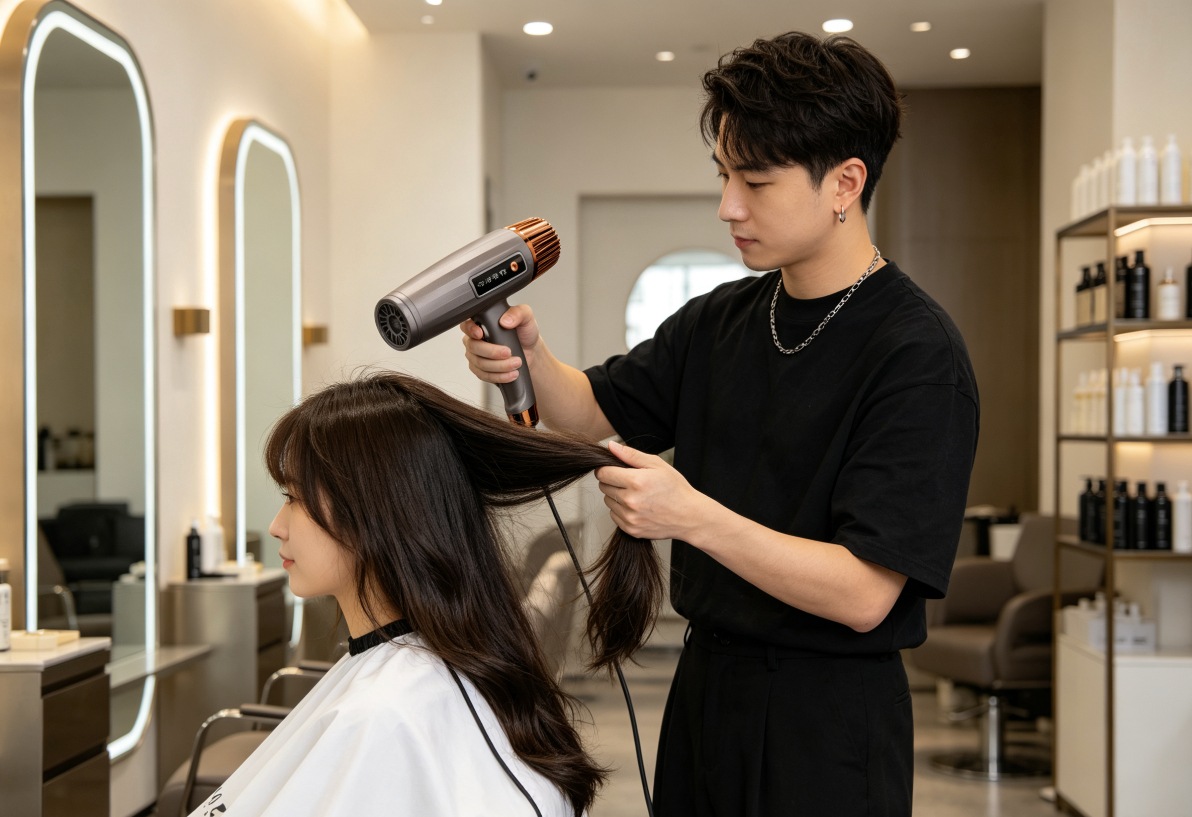
Product weight is easy to ignore on a specification sheet. In the hand, it is not so easy. Lightweight handling matters for blow-dry bars, hotel salons, training schools, and high-volume beauty spaces where dryers stay active for long periods.
Noise is another point that affects the mood of a salon. A low noise hair dryer helps create a calmer drying experience, especially when several styling stations are close together.
Heat Stability and Finishing Quality
The salon hair dryer is supposed to be fast drying without blasting heat. Stability of heat is important for color-treated hair, dry ends, thin hair, and straightening hair. Excessive uncontrolled heat can help save styling time; however, it can also make hair feel rough or frizzy.
Controlled airflow and stable temperature give stylists more room to adjust drying around roots, ends, and fragile hair sections.
Negative ion function also plays a role in the final look. It should not be described as repairing damaged hair. That would be too much. Its practical value is helping reduce static and frizz, making the finish look smoother and more polished.
Cleaning Design and Commercial Maintenance
Commercial tools collect dust, hair, and styling product residue. That is normal salon life. A dryer that is hard to clean may slowly lose airflow or require more frequent attention. This is one of those boring details that purchasing teams sometimes skip, then regret later.
A smart self-cleaning function can reduce cleaning pressure in daily use. For salons and B2B buyers, easier maintenance helps keep airflow more stable and reduces unnecessary service interruptions. It is not the flashiest feature, but it is the kind of feature that matters after the first month.
For distributors, maintenance design also affects customer feedback. A product that is easier to keep clean usually creates fewer basic complaints, especially when sold into professional environments with frequent use.
Supplier Capability for B2B Hair Tool Buyers
For salon groups, distributors, and private-label buyers, the product is only half of the decision. Supplier capability matters too. A good sample is useful, but repeat supply, quality control, certification, and communication decide whether the product can be scaled.
Link Beauty is a manufacturer and exporter of electric hair styling tools for professional salon and home use. The company offers OEM and ODM customization for global markets. Its manufacturing base is ISO9001-qualified, with 300 employees and a daily production capacity of 5,000 to 8,000 units. The company also lists certifications including CE, FCC, RoHS, PSE, SAA, GCC, and cETLus.
For B2B buyers, these details help reduce uncertainty. A salon hair dryer may need different colors, packaging, plug standards, brand labeling, or product positioning for different markets. A supplier with customization and production capacity can support that process better than a simple trading source.
Compliance and Responsible Sourcing Considerations
Responsible sourcing also matters in salon equipment purchasing. For distributors and private-label buyers, compliance marks, stable production control, and easier maintenance can reduce market-entry risk. Energy-saving or environmental claims should still be supported by real test data, not assumed from motor type alone.
When BLDC Technology Becomes the Better Fit
A 2400W brushless hair dryer is preferable if a consumer is looking for a product with good airflow, lightweight construction, low noise, advanced finish technology, and easy maintenance.
An AC hair dryer can still be suitable where buyers prefer traditional motor design, familiar operation, or a lower initial price range. The choice depends on market positioning.
Before selecting a dryer model, salon owners should consider various factors such as the motor used, power capacity, airflow information, weight of the body, sound levels, temperature control features, negative ion capabilities, cleanable features, compatibility with voltage, safety certification, OEM/ODM availability, and bulk ordering capability. This keeps the decision practical and prevents the purchase from becoming only a wattage comparison.
Conclusion
A professional dryer purchase in 2026 should be based on daily service value, not power alone. Compared with a traditional AC hair dryer, a 2400W BLDC hair dryer can offer stronger balance across airflow, handling, heat control, noise, finish, and maintenance. For salon equipment upgrades, distributor programs, or OEM/ODM hair tool projects, Link Beauty can support product selection and commercial supply based on real professional use. Buyers can contact Link Beauty to discuss specifications, bulk orders, and customization needs.
FAQ
Q1: What is the main difference between a BLDC hair dryer and an AC hair dryer?
A: A BLDC hair dryer uses a brushless motor, while an AC hair dryer uses a traditional AC motor.
Q2: Is a 2400W BLDC hair dryer suitable for salon use?
A: Yes. It can support frequent salon drying when airflow, heat control, and weight are well balanced.
Q3: Why does dryer weight matter for professional salons?
A: Weight affects hand and wrist comfort during repeated blowouts. A lighter salon hair dryer can make long working hours easier for stylists.
Q4: Does negative ion function repair damaged hair?
A: No. Negative ion function does not repair hair damage. It mainly helps reduce static and supports a smoother-looking finish.
Q5: What should distributors check before sourcing a BLDC hair dryer in bulk?
A: Distributors should check product specifications, certifications, production capacity, OEM/ODM support, voltage options, and long-term supply stability.